CSCI N241:Ralph Waldo Emerson
Famous Quote
Many people live their lives in a routine. Everyday they do the same thing and never long to change their ways. However, some people like to live their lives on the edge. never knowing whats next.
Ralph Waldo Emerson was a man with a dream to change the world. To push individualism and intuition in ones own spiritual believes. To see Emerson's story click this link.
Emerson's quote really shows a true message. Everyday people live their lives in a routine and eventually the day goes by in what seems like an hour. The quote is listed below.
"So much of our time is preparation, so much is routine, and so much retrospect, that the path of each man's genius contracts itself to a very few hours."
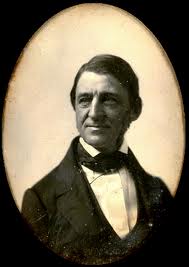
below is a picture of the great Emerson himself:
Ready to learn more about Emerson's life?
Waldo Emerson is truly the center of the American transcendental movement, setting out most of its ideas and values in a little book, Nature, published in 1836, that represented at least ten years of intense study in philosophy, religion, and literature, and in his First Series of essays. Born in 1803 to a conservative Unitarian minister, from a long line of ministers, and a quietly devout mother, Waldo--who dropped the "Ralph" in college--was a middle son of whom relatively little was expected. His father died when he was eight, the first of many premature deaths which would shape his life--all three brothers, his first wife at 20, and his older son at 5. Perhaps the most powerful personal influence on him for years was his intellectual, eccentric, and death-obsessed Puritanical aunt, Mary Moody Emerson. Yet Emerson often confessed to an innate optimism, even occasional "silliness." His undergraduate career at Harvard was not illustrious, and his studies at the Harvard Divinity School were truncated by vision problems, but he was ordained a minister of the Second Church in Boston, shortly before marrying Ellen Tucker in 1829. He resigned in 1832 after her death from tuberculosis, troubled by theological doctrines such as the Lord's Supper, and traveled extensively in Europe, returning to begin a career of lecturing. In 1835 he married Lydia Jackson; they lived in Concord and had four children while he settled into his life of conversations, reading and writing, and lecturing, which furnished a comfortable income. The Emerson house was a busy one, with friends like Elizabeth Hoar, Margaret Fuller, and Henry Thoreau, staying for months to help out and talk. He, Bronson Alcott, and George Ripley decided to begin a magazine, The Dial, with Margaret Fuller editing, in 1840; Emerson would edited the final two years, ending in 1844. His Essays (first series) were published in 1841. Meanwhile, tragedy struck with the sudden death of his five-year old son Waldo in 1842, soon after the death of John Thoreau from lockjaw, and a darker, tougher strain appears in Emerson's writing, beginning with his memorializing poem, "Threnody." But Emerson pulled himself together to give a series of lectures in New York and in 1844 he had a new volume of essays prepared. He began planning a series of lectures on great men and publication of his poems in 1846, while speaking out against the annexation of Texas and reading deeply in texts of Persian and Indic wisdom. In 1845 he began extensive lecturing on "the uses of great men," a series that culminated with the 1850 publication of Representative Men; by that year he was giving as many as 80 lectures a year. Through a career of 40 years, he gave about 1500 public lectures, traveling as far as California and Canada but generally staying in Massachusetts. His audiences were captivated by his speaking style, even if they didn't always follow the subtleties of his arguments. In 1847 Emerson travelled to England, noticing in particular the industrialization and the chasm between upper and lower classes. When he returned to Concord nine months later, he had a new approach to English culture, which he expressed in his lectures on the "Natural History of Intellect" and his 1856 book, English Traits. In 1851 he began a series of lecture which would become The Conduct of Life, published in 1860. He was vigorous in middle age, traveling frequently, but was increasingly aware of his limits and failing energy. He had become quite famous, a major figure in the American literary landscape, a celebrity which brought both adultation and satire. He had been a profound inspiration for many writers, especially Henry Thoreau and Walt Whitman. He continued his speeches against slavery, but never with the fire of Theodore Parker. In 1857 he wrote an essay on "Memory" but ironically, in his later years, his own memory would falter, especially after his beloved house burned in 1872. He died quietly of pneumonia in 1882. Ann Woodlief
Emersons life according to Wikipedia
Ralph Waldo Emerson's Biography
Ralph Waldo Emerson (May 25, 1803 – April 27, 1882) was an American essayist, lecturer, and poet, who led the Transcendentalist movement of the mid-19th century. He was seen as a champion of individualism and a prescient critic of the countervailing pressures of society, and he disseminated his thoughts through dozens of published essays and more than 1,500 public lectures across the United States. Emerson gradually moved away from the religious and social beliefs of his contemporaries, formulating and expressing the philosophy of Transcendentalism in his 1836 essay, Nature. Following this ground-breaking work, he gave a speech entitled The American Scholar in 1837, which Oliver Wendell Holmes, Sr. considered to be America's "Intellectual Declaration of Independence".[1] Emerson wrote most of his important essays as lectures first, then revised them for print. His first two collections of essays – Essays: First Series and Essays: Second Series, published respectively in 1841 and 1844 – represent the core of his thinking, and include such well-known essays as Self-Reliance, The Over-Soul, Circles, The Poet and Experience. Together with Nature, these essays made the decade from the mid-1830s to the mid-1840s Emerson's most fertile period. Emerson wrote on a number of subjects, never espousing fixed philosophical tenets, but developing certain ideas such as individuality, freedom, the ability for humankind to realize almost anything, and the relationship between the soul and the surrounding world. Emerson's "nature" was more philosophical than naturalistic; "Philosophically considered, the universe is composed of Nature and the Soul." While his writing style can be seen as somewhat impenetrable, and was thought so even in his own time, Emerson's essays remain among the linchpins of American thinking, and Emerson's work has greatly influenced the thinkers, writers and poets that have followed him. When asked to sum up his work, he said his central doctrine was "the infinitude of the private man."[2]
See more of Emerson's life by clicking the link